
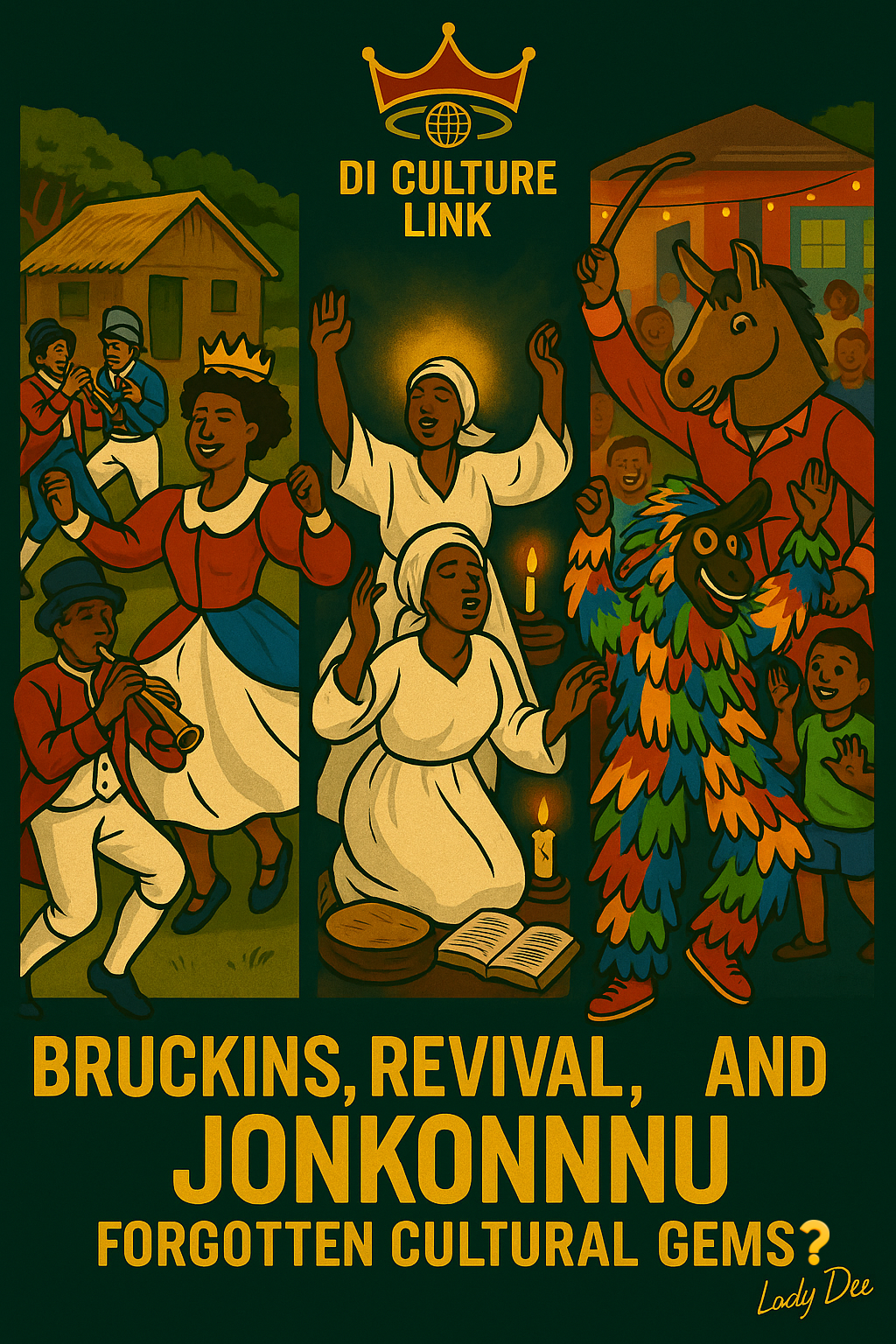
Long before stage shows, sound clashes, and TikTok challenges, Jamaicans danced for something deeper—liberation, spirit, and cultural survival.
Across the island’s history, three powerful performance traditions emerged from the blend of African ancestry and colonial resistance:
Bruckins, Revival, and Jonkonnu.
Today, they are rarely seen by the mainstream public. But they’re not lost. These are not just dances. They are rituals. They are resistance. They are reminders of who we are—and where we come from.
Bruckins – The Dance of Emancipation
Bruckins (sometimes spelled “Brukins”) is a traditional Jamaican dance-play performed in honour of Emancipation in 1838.
It blends European-style ceremonial movements with African rhythm and style, creating a symbolic performance about freedom and transformation.
• The performance usually involves two groups: the “Queen” and her royal party (symbolising freedom), and the “Red Coats” (representing colonial rule).
• Dancers wear elaborate red, white, and blue costumes, often to the sound of fife and drum.
• The dance is part celebration, part satire, and part spiritual release.
Though largely forgotten in urban spaces, Bruckins is still alive in Kensington, Portland, where older residents continue to pass down the tradition with the support of the Jamaica Cultural Development Commission (JCDC).
Revival – Spirit in Motion
Revival is not just a performance—it’s a full spiritual system.
Born from the merging of African Myalism and Christian faith, Revival offers healing, connection, and ancestral guidance through song, movement, and possession.
Revival ceremonies are still practiced across Jamaica today and include:
• Lively drumming and handclapping
• Participants moving in circles, sometimes entering spirit possession or trance
• Healing rituals and prophetic messages
• Special clothing, such as white headwraps or bright, flowing garments
Revival is celebrated in events like the National Revival Conference and Church Service, and remains especially vibrant in parishes like Clarendon, St. Mary, and St. Thomas.
It continues to be misunderstood by many, but for those who know, Revival is a living, breathing link to African spirituality and Jamaican resistance.
Jonkonnu – Masquerade and Mockery
Jonkonnu is one of the oldest and most colourful of Jamaica’s traditional festivals.
It began during enslavement, when Africans were given a brief holiday during Christmas. But instead of just celebrating, they used performance as protest.
• Characters include Pitchy Patchy, Horse Head, Devil, and Cow Head
• Costumes are made of bright cloth, bells, horns, and whips
• Performers dance through communities with drums, fifes, and theatrical flair
• The acts often mock colonial figures or exaggerate African spirits in disguise
Today, Jonkonnu is still performed—but barely.
Only a few active groups remain, and the tradition faces challenges like:
• Low public awareness
• Lack of funding and resources
• Declining interest among younger generations
Still, efforts are being made to preserve it. Events like the Jonkonnu Road March and Competition in Kingston, supported by the CHASE Fund and the Institute of Creative Training and Development (ICTD), are helping to keep this vibrant performance art alive.
Why These Traditions Still Matter
Bruckins, Revival, and Jonkonnu are not just old-time practices.
They are evidence of how Jamaicans survived colonialism, protected identity, and kept African memory alive through performance.
Each movement tells a story.
Each drumbeat holds resistance.
Each costume says, “We were here. And we still are.”
Why Di Culture Link Is Sharing This
Because culture is not only what’s trending.
It’s also what nearly slipped away.
At Di Culture Link, we highlight these traditions because they show that Jamaica is more than reggae and rum. We are spirit, story, dance, and defiance. And if we don’t protect these gems now, we risk losing parts of ourselves.
These cultural expressions are not dead.
They’re just waiting fi more people to call dem name again.


 Di Culture Link