
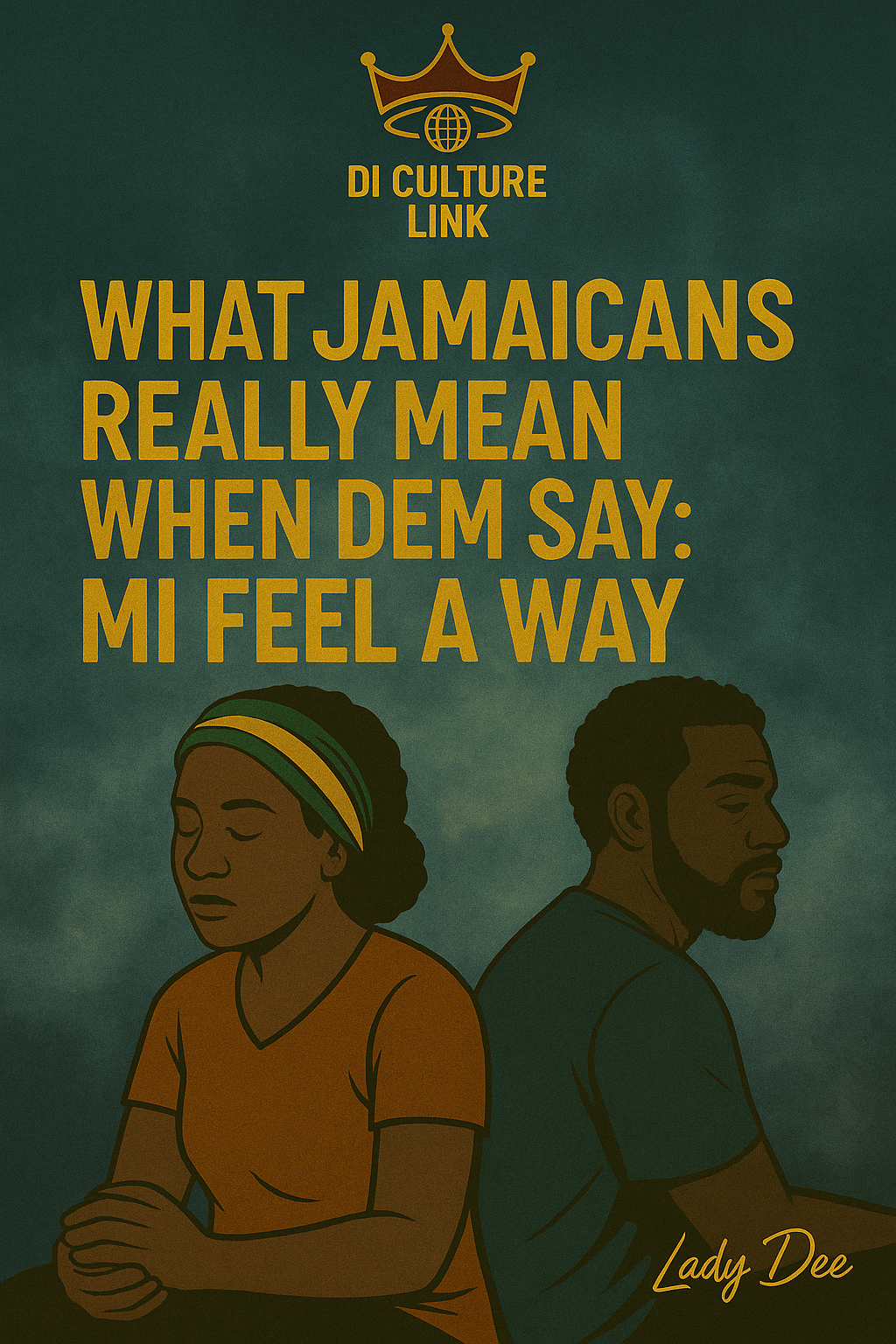
“Mi feel a way.”
It’s one of the most common and most loaded phrases in Jamaican language. At first, it might sound vague, like the person doesn’t know how they feel. But in truth, it says a lot without saying too much.
It’s how Jamaicans express discomfort, hurt, disappointment, or even quiet anger without having to go into detail.
It’s not about being dramatic. It’s about being guarded, self-aware, and emotionally intelligent in a culture that often teaches strength over sensitivity.
The Many Meanings Behind “Mi Feel a Way”
Depending on tone and context, this phrase can mean:
• “Mi feel left out.”
• “Mi feel a way ’bout how yuh talk to mi.”
• “Mi disappointed, but mi respect yuh too much to argue.”
• “Mi hurt, but mi nuh ready fi open up.”
• “Mi shame, mi vex, mi confused… but mi trying to hold it together.”
It’s how someone might say:
“Mi feel embarrassed. Mi feel belittled. Mi feel disrespected… Mi feel a way.”
Jamaicans often say it when something touches their pride, their love, or their expectations.
It’s a phrase that hides tears behind tone. And that tone speaks volumes.
Why It’s So Widely Used
Jamaicans come from a history of strength, survival, and holding things close to the chest.
From plantation trauma to family struggle, emotional restraint became part of survival.
“Mi feel a way” became a safe space in the language. It’s something you can say without looking soft, yet still honouring how you feel.
It’s especially common among:
• Men, who may not feel free to express vulnerability
• Women, who want to express pain without being labelled “too sensitive”
• Friends, trying to navigate hurt without fallout
• Elders, who grew up hearing:
“Yuh too nuff.”
“Stop act soft.”
“Children must be seen and not heard.”
“Know yuh place when big people deh near.”
Those phrases taught generations to mute emotion. So when someone says “Mi feel a way,” it’s not weakness. It’s restraint. It’s strength shaped by experience.
Where It Shows Up
• A friend invite everyone but you: “Mi feel a way still.”
• Somebody interrupt you in front of a crowd: “Mi feel a way ’bout how dat go down.”
• You reach out and get ignored: “Mi nah lie, mi did feel a way.”
• You see someone post a comment that sting: “Mi spirit tek it, but mi feel a way.”
In each case, the person is choosing emotional control over confrontation, but still naming the pain.
Why This Phrase Matters
In a world that pushes people to get over it, this phrase says:
“I’m not okay, but I’m not here to fight. I just need yuh to know.”
That’s emotional maturity in cultural code.
It’s a survival tool, especially in relationships, family dynamics, and public spaces where Jamaicans are expected to be strong.
It creates a middle ground between silence and explosion.
Why Di Culture Link Is Sharing This
Because our language is more than expression. It’s emotional architecture.
“Mi feel a way” is how Jamaicans carry emotion with grace.
It’s how we signal discomfort without disrespect and name hurt without losing pride.
At Di Culture Link, we celebrate this phrase not because it hides pain, but because it manages it with elegance. It reminds us that even in cultures built on resilience, there are still spaces for softness, truth, and healing.
So next time you hear someone say “Mi feel a way,” listen deep.
Because they just told you a whole story with one simple phrase.

 Di Culture Link