

The market is more than just a place to sell food. It is a battleground of energy, a spiritual testing ground, and for many, a place where business and protection move side by side. What people see are stalls and shouting. What they don’t see is the salt under the counter, the Psalm whispered before dawn, or the powder dashed before the sun rise.
Obeah, though outlawed, is not absent. It moves in silence. It guides hands. It shields space. And in the market—where the stakes are high and the competition is real—it often becomes the difference between a day of blessings or a day of losses.
The Root of Obeah in the Caribbean
Obeah came to Jamaica through enslaved Africans, particularly from the Akan, Igbo, and Kongo cultures. It refers to a system of spiritual knowledge and manipulation of natural forces—including herbs, spoken word, ancestral communication, and divination. British colonisers criminalised Obeah because they feared its influence. It gave enslaved Africans power, unity, and the ability to resist spiritually. The Obeah Act of 1898 remains on Jamaica’s books today, though rarely enforced. What began as resistance became a complex system of spiritual survival in post-slavery Jamaica.
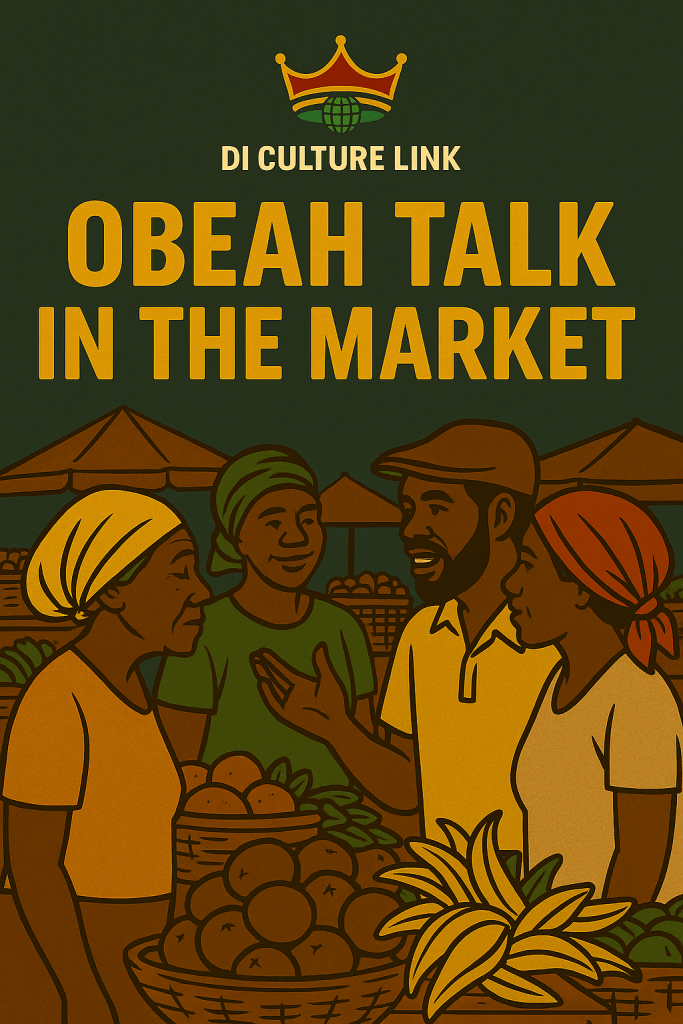
Market life is more than trade—it’s tradition, protection, and power. Obeah walk quiet through stalls where business and spirit meet. This is Di Culture Link!
Obeah in the Market: Not Myth, but Method
In the heart of markets across the island—from Coronation Market in Kingston to the arcades of Linstead, Spanish Town, Brown’s Town, and MoBay—vendors operate with more than just sales strategy. Some wear white headwraps with intentional symbolism. Others sprinkle blended powders at the four corners of their stall before sunrise. Bottles of lime, garlic, or water placed under tables are not for show—they are spiritual shields. Obeah appears in quiet acts: A vendor washes her stall at dawn with water, lime, and camphor. A red string is tied to the stall frame to stop bad mind. A Psalm is whispered before opening, sometimes Psalm 35 or Psalm 109. A small bottle hidden in plain sight may contain oil or rum mixed with herbs, blessed or fixed. These vendors often do not use the word “obeah.” They may say “mi spirit tell mi,” or “mi tek precaution.” But what they’re doing is rooted in a system of ancestral protection and spiritual transaction.
The Economics of Protection
Market spaces are competitive. Hundreds of vendors vying for the same customer, side by side. A good day could feed a family. A bad week could ruin a household. So vendors don’t just prepare goods. They prepare the spiritual space. There are whispered stories of stalls that used to be full every day suddenly “turn dead.” Other vendors say they “feel a darkness” pass dem or that someone “sprinkle di place.” The response? Vendors visit spiritual advisors, readers, or herbalists. Some pay for spiritual cleansing. Others seek return-to-sender oils, fixed candles, or instructions to bathe before dawn with “bush inna bottle” mixtures—often including ingredients like strongback, garlic, sour lime, guinea hen weed, or even 40-leg (centipede). The use of Obeah here is not random. It is specific. It is structured. And it is passed quietly, often from one elder to another.
Herbs, Rituals, and Code
The bush used is rarely random. Some examples: Guinea hen weed for clearing space. Strongback and spirit weed to strengthen energy. Cerasee and bitter bush to remove spiritual buildup. Lime for cutting crossing. Salt for sealing and protection. Rum or white overproof as a carrier and purifier. These herbs and items are used not in isolation but often with spoken word, prayer, or ancestral invocation. Some vendors fast before they prepare. Some use a reader to determine the right time. Others light candles hidden under their stalls at night before market day.
Obeah and the Law: A History of Silencing
The Obeah Act (1898) criminalises anyone practising or claiming to practise Obeah. But the law was not about spiritual safety. It was about colonial control. Obeah was used in slave rebellions, and the authorities recognised its power. For this reason, many practitioners still operate quietly. There are no signs that say “Obeah Man Here.” But people know who to ask, where to go, and how to speak in code. Even those who don’t “practise” still take precautions. Whether it’s calling the reader for insight, wearing a protective charm, or avoiding touching certain things on a rival’s stall—belief is present even in silence.
Why It Matters
Obeah in the market is not about theatrics. It is about survival. It is not always about harm. It is more often about protection. And for many Jamaicans, it is not an option. It is a necessary layer of defence in a world where spiritual and physical danger often meet. At Di Culture Link, we hold space for these realities not to romanticise them, but to record them. To say what many know, but few write down. Because these practices, whether you believe in them or not, are part of how people live, work, and guard their wellbeing in real Jamaican life.

 Di Culture Link